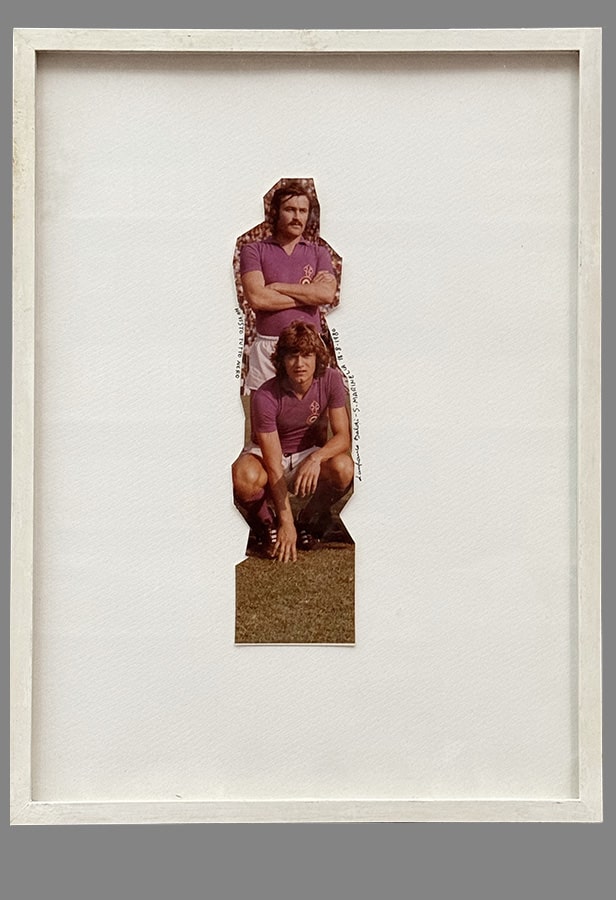

The significant interest and success of the exhibit “Una rete visibile. Lanfranco Baldi tra opere e relazioni » has created the opportunity to extend it until June 5th, allowing visitors to explore the evolution and research themes of this remarkable artist’s creations through the series of works on display here.For those unable to go to the Library of the Academy of Fine Arts of Florence at Via Ricasoli 64, and for readers of ArtSixMic, we include here some of the works on display and the accompanying commentary on the exhibition.
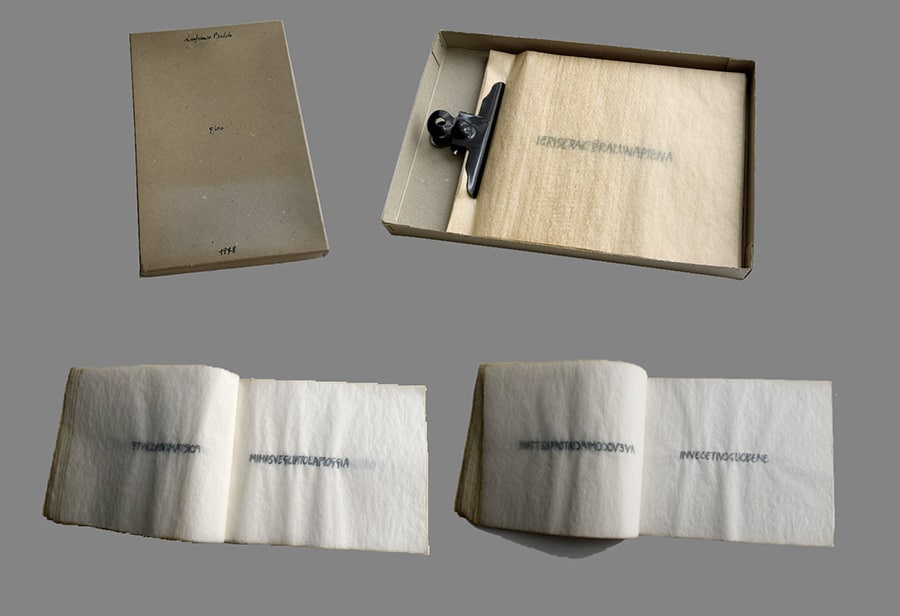
20 frasi raccolte in situazioni diverse, 1978. Tissue paper, cardboard box, and fleece (multiple in an edition of 100). The work consists of a book-object that transforms into a minimal archive of lived language, all united by the work Mio caro (My Dear), in which Baldi transforms phrases collected in reality into a serial and fragile artistic device, bringing writing, memory, and relationships into tension. The constellation of statements he proposes rejects both semantic closure and the authority of the author, configuring itself as a permanent work in progress, capable of activating an intermittent and shared memory in the spectator. Unlike artists of Visual Poetry, such as Maurizio Nannucci and Ketty La Rocca, Baldi does not use words as a critique of the mass media or to affirm or codify meanings, but rather to challenge their validity, transforming them into traces of relationships and situations. (L. Bruni)
-Azione, Galleria Unimedia, Genova 1979. Documentation of thirty photographs by Piero Biasion. The documented action fits perfectly into Lanfranco Baldi’s practice between the late 1970s and early 1980s, when his work developed as a combination of gesture, word, community, and exhibition devices. It is configured as a situated event, in which the artist operates on the border between the public dimension and individual gesture: it does not represent, but activates a situation, a temporary field capable of generating relationships and memory. The photographic documentation resurfaced only after its author, Piero Biasion, found it only after he had participated in the study day and inauguration of the exhibition, when he searched in his material. This discovery highlights how Baldi’s journey is still largely latent, scattered among unused materials. In this sense, the case becomes emblematic of a broader condition: the need to build a new critical focus around his work, capable of reactivating documents, memories, and research perspectives that are still unexplored. (L. Bruni)
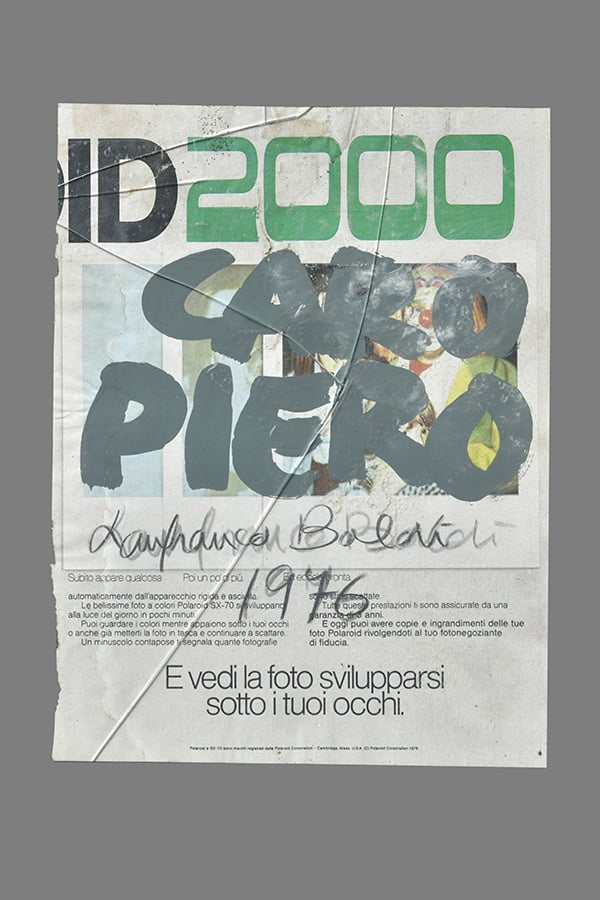
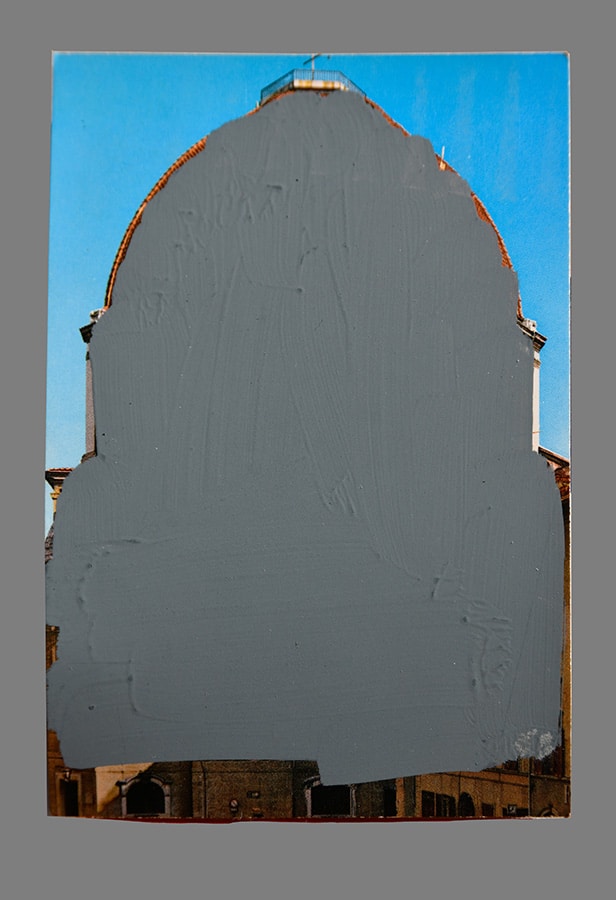
- Caro Piero, 1976. Polaroid advertising on a page torn from the weekly magazine Panorama, which had added the words “Dear Piero” in a neutral/greenish tempera, initially signed in pencil as was his custom and then in pastel. Piero Biasion recalls: « I received this dear Piero on one of those laminated, primary-colored cards we were so fascinated by. Several of these sheets, in various formats, are contained in the folder, along with a series of his other works that he left me when he moved permanently from Genoa to Florence.” As a photographer who used to develop his rolls, receiving the sheet with “And you see the photo develop before your eyes” is a touching poetic message of closeness to my work. It is work that is part of that evolution from the material signs created with industrial cardboard and packing tape to the creation of a « Morse language » made of signs. This was followed by paintings and painted cancellations, moving on to the formulas of topical speech, continuing to investigate the unexpected poetics born from the association of more or less rhetorical images transformed into something else by the addition of words/phrases.
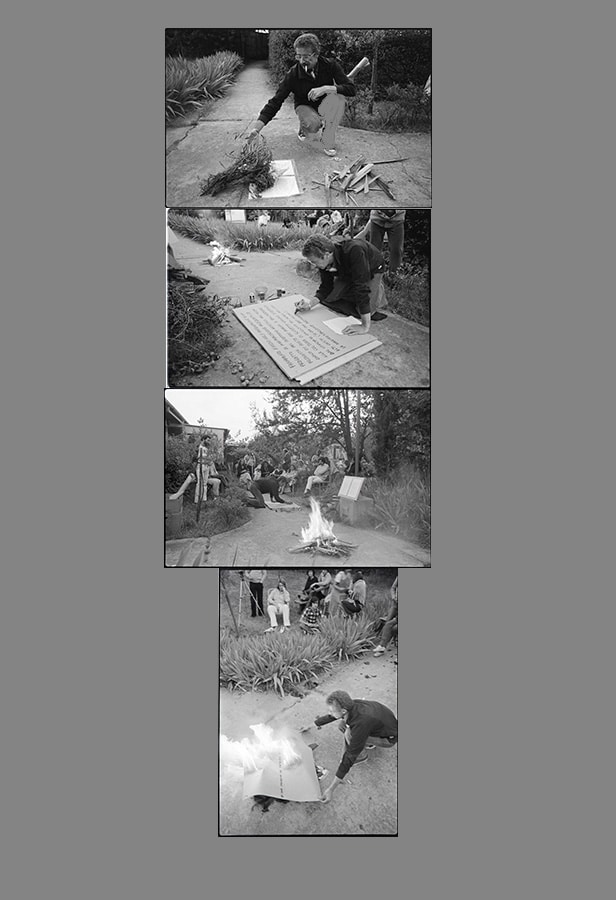
Edizione in pubblico (Fiera del Loretino, Firenze), 1979. A photographic documentation of 53 shots by Gianni Melotti. Melotti’s images of this work are the only evidence of the event in general and of the specific project, which challenged the official nature of the art system and the finished work, ready to be released into the art market, which would soon become very demanding. The work, in its ritualistic simplicity, evokes a call for community. (L. Bruni) His artist friend and photographer Gianni Melotti remembers this particular action: Lanfranco Baldi is photographed transcribing a text onto large sheets of paper, which he then immediately burns on a fire. The text’s content is taken from an exhibition proposal for the Municipality of Forte dei Marmi, in Versilia, proposed by curator and friend Pier Luigi Tazzi. The exhibition, entitled « Gita al Mare, » featured the participation of many international artists. The budget for its realization was rejected, and the project fell through.
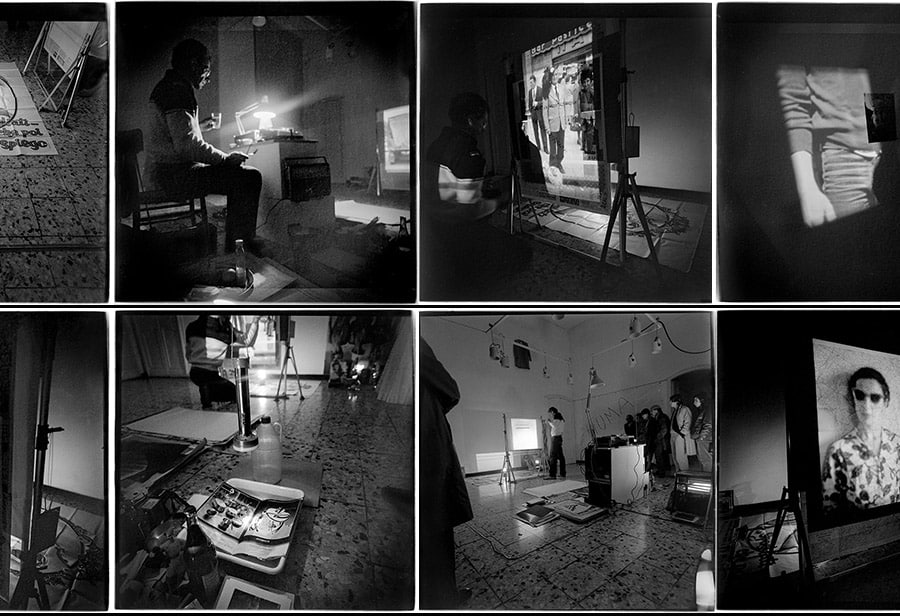
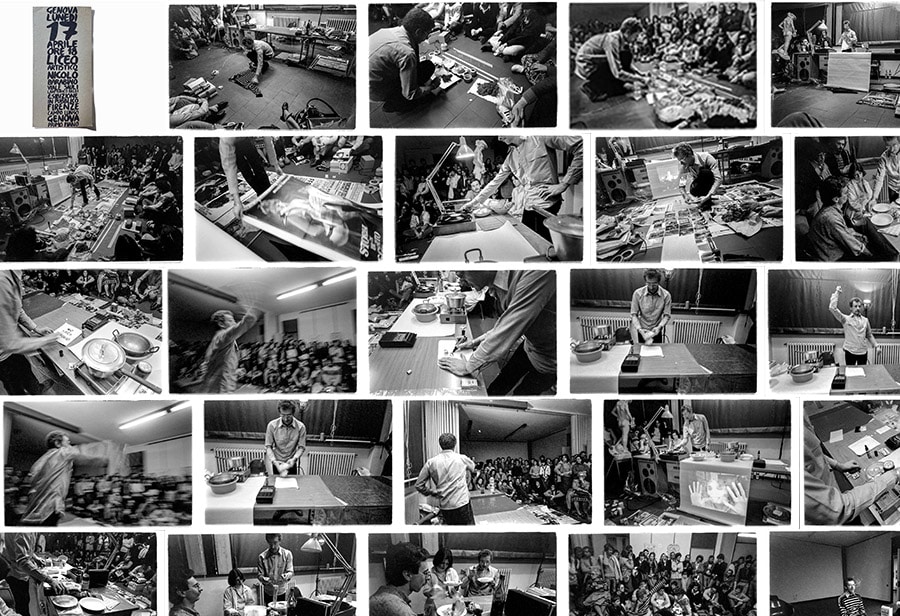
Genova, primo piano (Firenze, campo lungo). Monday 17 April at 6.00 pm Niccolò Barabino Art High School, 1979. Photographic documentation by Piero Biasion composed of 84 images. Piero Biasion, a photographer friend and author of the documentation, recalls the event as follows: Lanfranco gave me no instructions, much less explanations, about what he was going to do or its meaning. He asked me to take photographs. He asked me to lend him the stereo system with a turntable, amplifier, and speakers, a slide projector, and the assistance of my brother Fiorenzo to operate it during the action/representation. The action took place in the hallway of the high school where he taught in Genoa. With the help of two janitors, he placed a table covered with a sheet of clear plastic in the center of the stage and placed a plaster cast of a Renaissance sculpture next to it, orienting it toward the normally less frequented side.
This choice reaffirms his approach: starting from a common and preconceived perception to activate, through small shifts, a new poetic vision of reality. This approach underpins the entire action of that event, starting with the presentation of the materials he used for his works at the time: industrial cardboard, string, packing tape, clay, plasticine, posters of various types and genres (from a pseudo-erotic one to one for the exhibition of artists from that high school). He activated musical toys with accompanying music boxes for children, including a spinning top whose sound enchanted. She then recorded the sounds/jingles with a portable cassette recorder. Meanwhile, the slide projector alternated between everyday images we all know, as well as private ones, then generic ones, from a panoramic view of Florence to group photos and a portrait of a loved one. Given the fame he enjoyed, there was a large turnout of students and fellow artists/teachers who had perplexed expressions (including the principal), however the buzz of the students could be clearly heard. Lanfranco was imperturbably focused on what he was doing and interpreting, only for a moment did he interrupt his modus operandi when, with spaghetti in his mouth, he looked at me for a moment while I was photographing him, as if to ask me if everything was working. The cigarette at the end of everything was liberating and well-savoured, like the one of the principal which ended her tension.
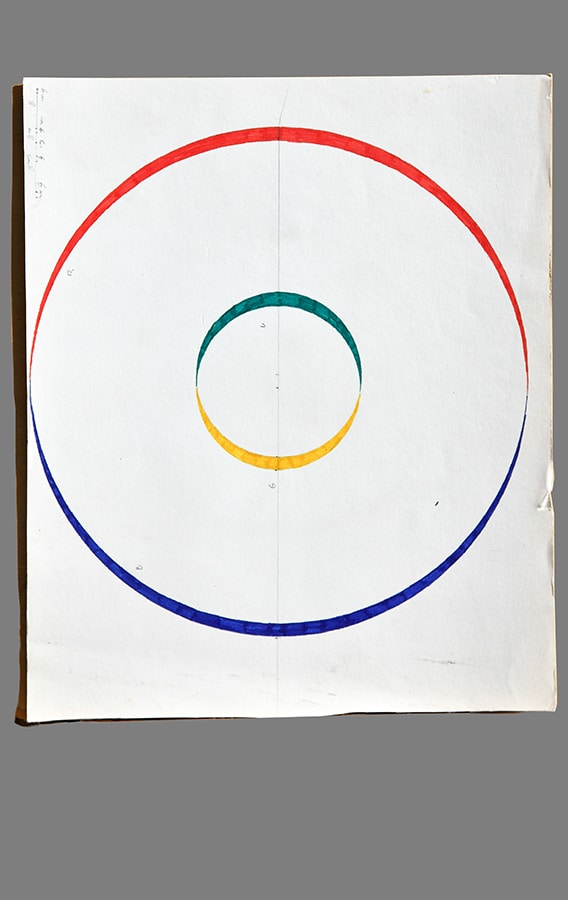
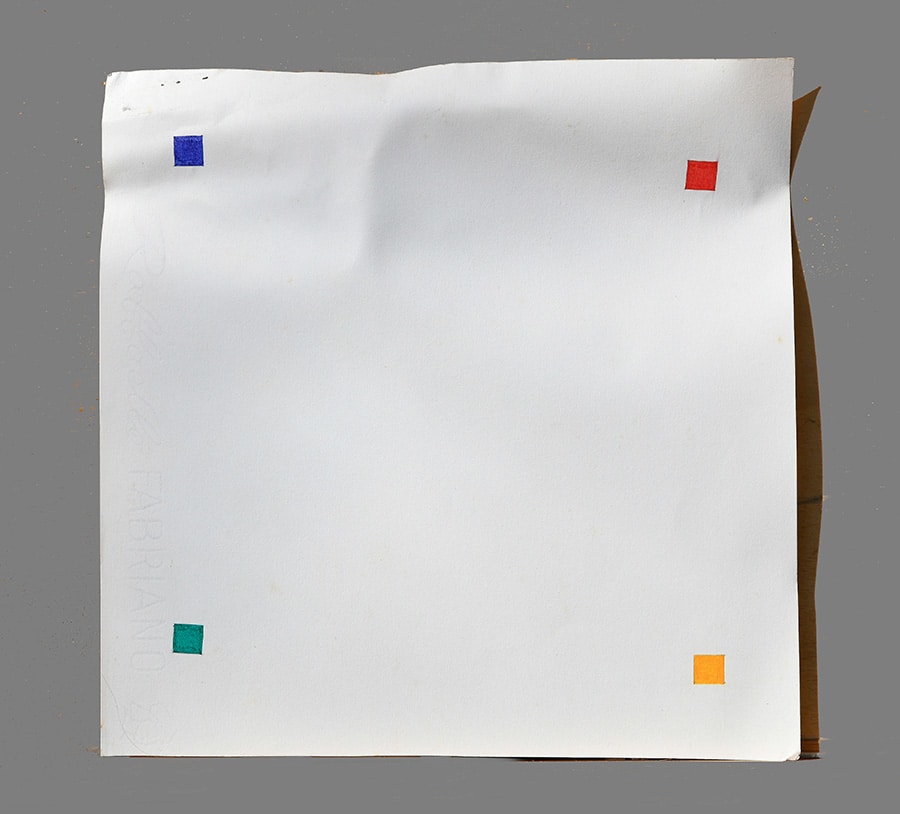
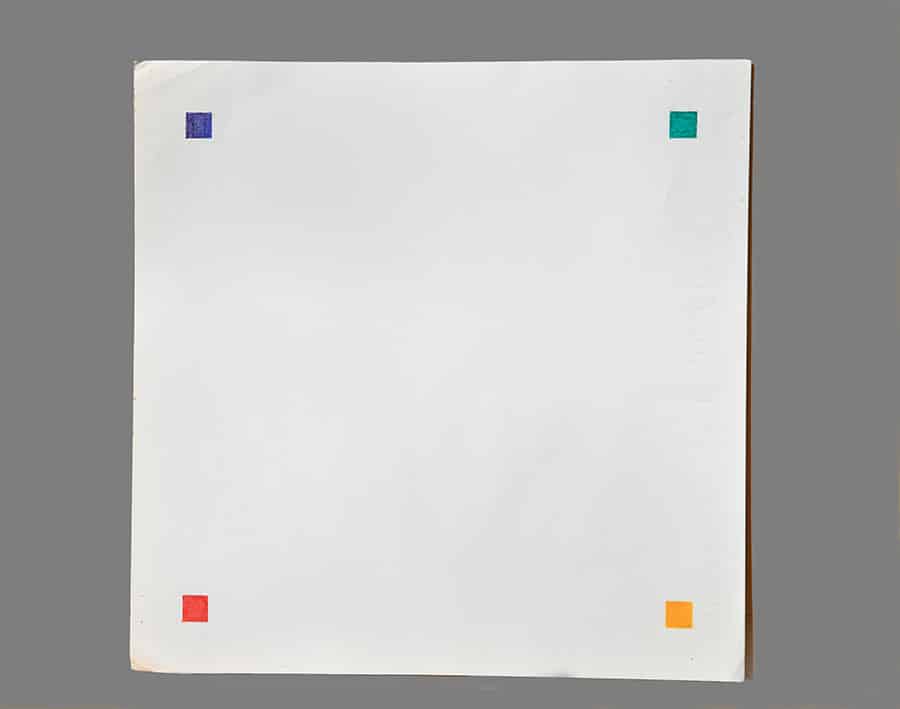
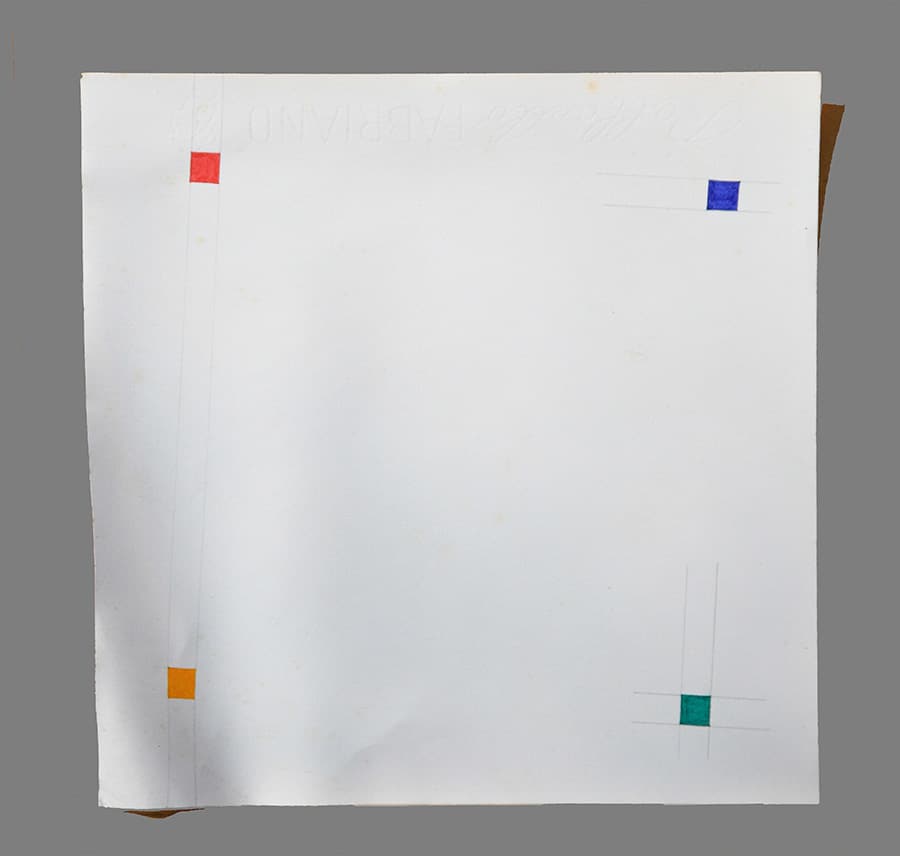
Geometrie del colore 0, Geometrie del colore 1, Geometrie del colore 2, Geometrie del colore 3, 1972.
Sheets of paper and colored marks. His Genoese friend and photographer Piero Biasion recalls: « These are studies/sketches for multiples of abstract works.” They are part of the elaborations following the reading of the famous and powerful book on Klee’s complete works published that year. It should be noted that the clarity of cleanliness in these works is not accidental or influenced by the book. It is a feature that is already present in the work/object contained in the 1966 Multibox created for the F/One Research Centre and which consisted of two tubular metal elements that could be combined in various ways. A composition that Lanfranco then developed as a support element for the table in the house/studio at Viale Francesco Petrarca n.54. The sketches on display were contained in the folder he gave me when he left Genoa for good to return to Florence. A giant version of the two tubes appears to support the table shown in the photo I took, of the Lanfranchian ensemble of the lamp, the large work on the wall, and the table set with the excellent cake made by his mother.
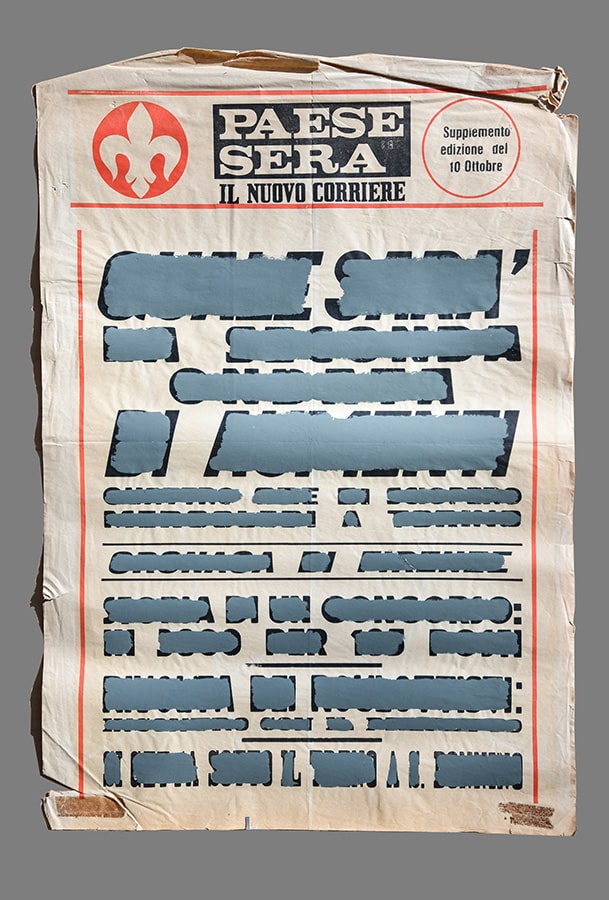
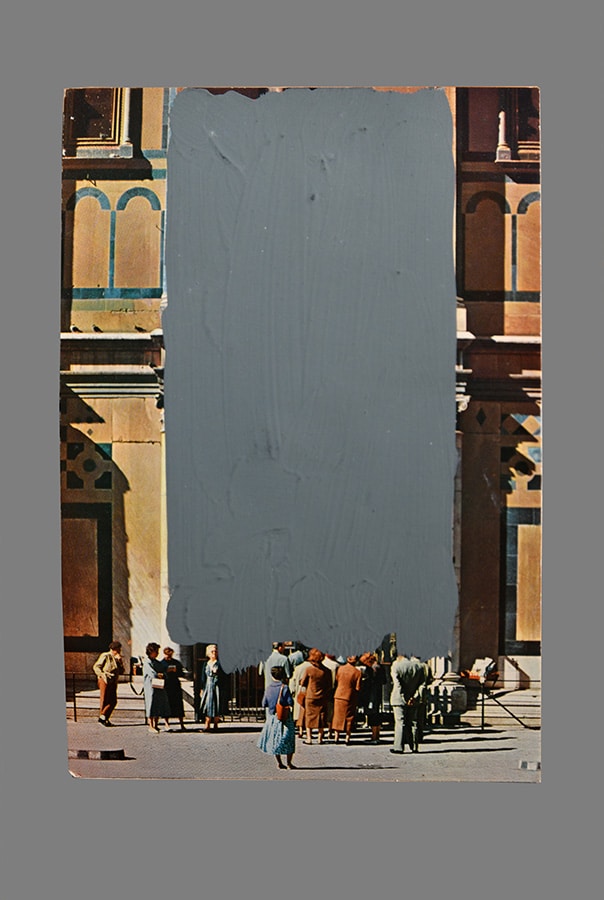
Il Nuovo Corriere, 1975. Image taken from the magazine Paese Sera, of an Owl with parts erased with neutral/greenish paint. Piero Biasion recalls: He brought it to me in the studio I had at Vico alla chiesa delle Vigne 18r in Genoa. It was wrapped in a sheet of Bristol board folded in two. This work is the evolution of a series of previous works in which he explored the sign—the brushstroke and its variations—as if to visualize the sounds of a poetic discourse. Here, the relationship between the « stain » and the writing becomes evident, provoking a new sensitive form. -Image Laboratory (Galleria Schema), 1979.
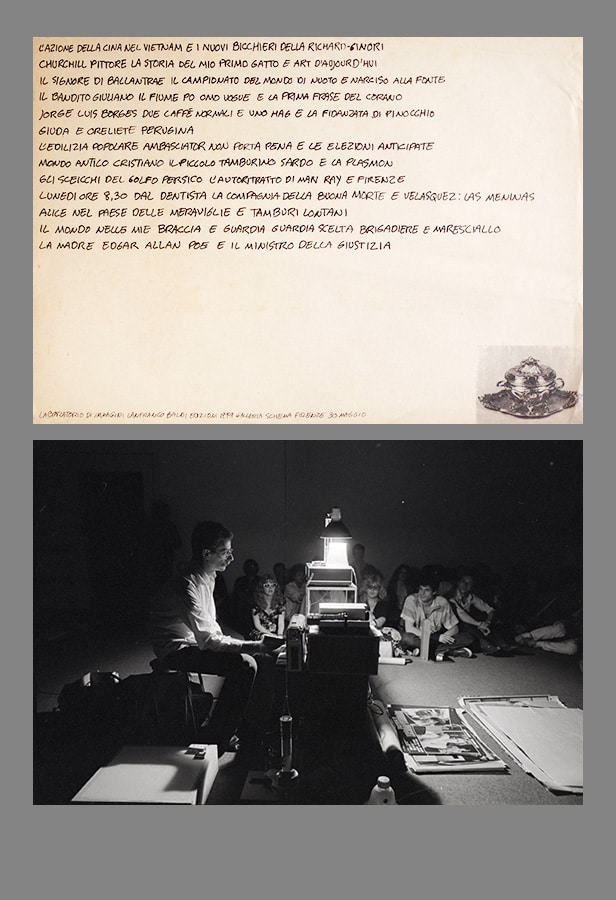
Print of a photographic contact sheet and typewritten sheet. The edition, produced for Lanfranco Baldi’s action at the Galleria Schema in Florence in 1979,It does not consist of direct documentation of the event, but of an enlargement of a photographic contact sheet taken from one of the shots taken by Gianni Melotti that evening. This choice introduces a significant shift: the focus shifts from the event to the process of its recording and its interpretation, transforming the track into an open device that highlights the multiplicity of points of view. This aspect is further strengthened by the selected image, which does not show the artist’s action, but the audience and the collective dimension of the experience, conveying the climate of participation and shared observation. The print is accompanied by a typewritten sheet by Baldi himself which does not describe the action but rather lists the objects present and used that evening. The work thus emerges as a reflection on the relationship between action, memory, and documentation, in line with Baldi’s practice, which, in the late 1970s, conceived both action and photography not as the outcome of something, but as a process and the activation of relationships. (L. Bruni)
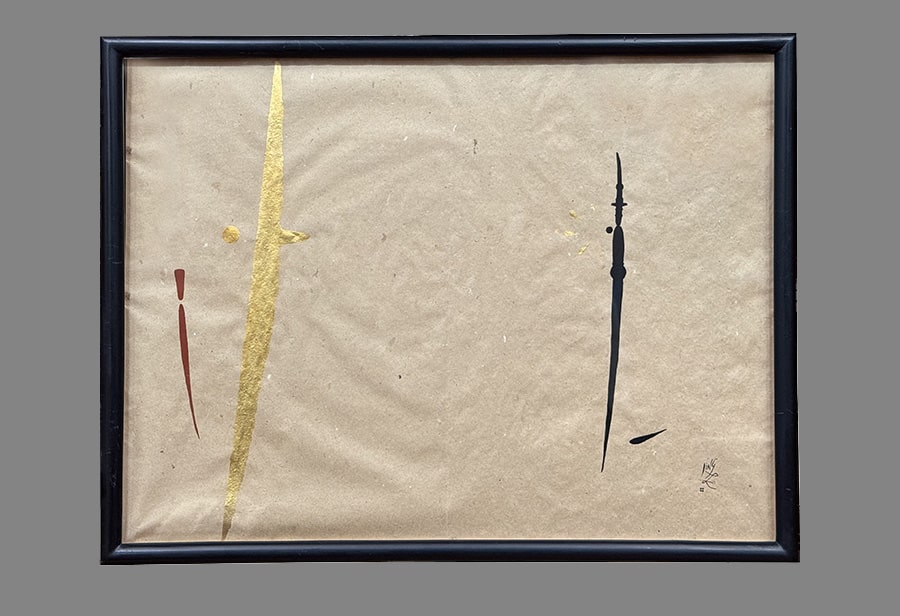
Jing (Lanfranco Baldi), Le ombre della sera, late 1980s.Ink on yellow wrapping paper.
Raimondo Gramigni, architect, friend, and founder—together with Pier Luigi Tazzi and Gianni Melotti—of the Lanfranco Baldi Foundation in Pelago, recalls: I met Lanfranco when he invited himself to dinner at my house, being a neighbor. The drawing he gave to Lela and me, in the late 1980s, was always a joke: we’d ask each other which of the three was represented in those essential signs on yellow paper. He identified with the small, distant sign; Lela and I, however, would argue over who was responsible for the two remaining « shadows of the evening. »
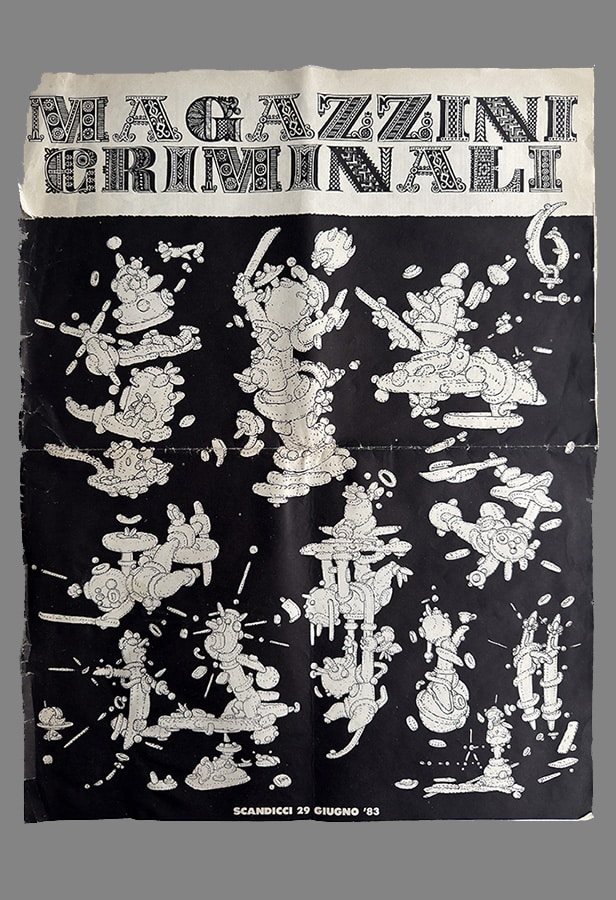
Jing (Lanfranco Baldi), Magazzini Criminali, 1983.Cover for the magazine “Magazzini Criminali”, n.6, June, 1983. Sandro Lombardi (actor and founder of the Magazzini Criminali group) recalls: I met Lanfranco through Pier Luigi Tazzi, who was part of our group Il Carrozzone from 1975 to 1980. The understanding between us was immediate and over time it became a true friendship, culminating in artistic collaborations such as the drawing that served as the cover for the sixth issue of the magazine Magazzini Criminali. We also went on trips together, Federico Tiezzi was also there, mainly to Morocco, guests of the Spanish artist Juan Román (who also deserves to be rediscovered). Lanfranco was part of a group of artists, mainly Florentines but not only, with whom we established relationships of friendship or work, more often both: Roberto Cerbai, Ketty La Rocca, Verita Monselles, Alighiero Boetti…
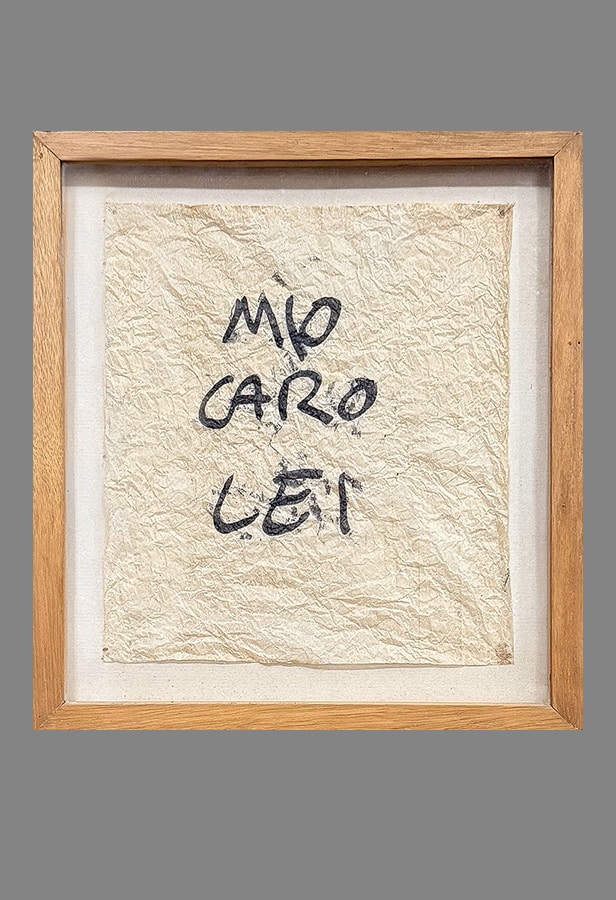
Mio caro lei, 1970s – Ink on tissue paper. The work donated by Baldi to P.L.Tazzi subtly testifies the subversive and at the same time emotional dimension of Baldi’s research, revealing something about their relationship – the one between artist and critic, but also the one between friends – and also about the character of the recipient himself, shrewd and distrustful. The formal language of “lei” confronts the familiarity of “mio caro” (my dear) and the instability of handwritten capital letters, activates a tension between distance and intimacy. Baldi approached this practice in the 1970s, personally reinterpreting the use of words typical of conceptual art and visual poetry. This work clearly reveals the poetics developed by Baldi in the 1970s, which led him to use formulas from everyday rhetoric and humble, fragile materials like tissue paper to question social codes and linguistic conventions. The drawing surface is transformed into an intimate space, closer to a note or a private message than to a traditional pictorial work, marking at the same time a move beyond the previous relationship he had established with the canvas and geometric painting. (L. Bruni)
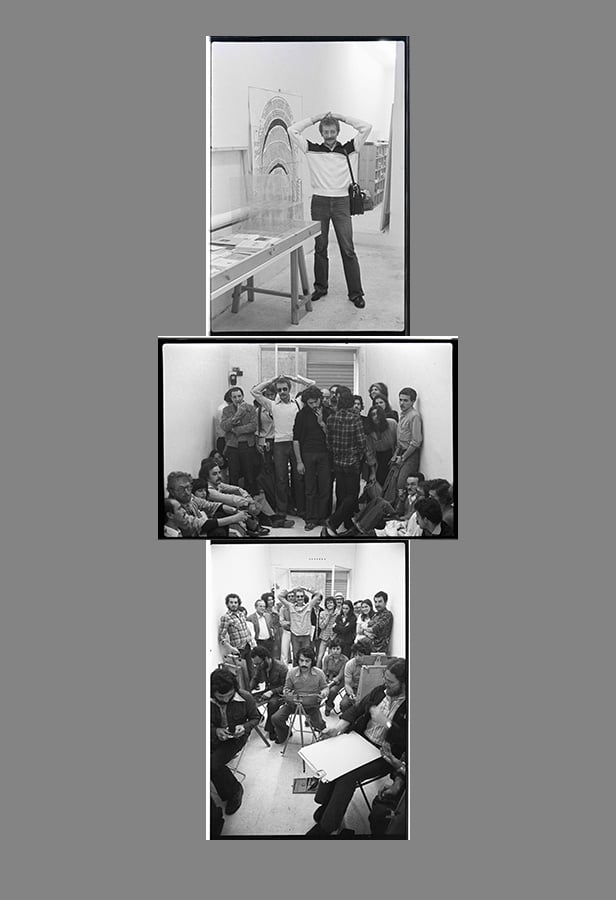
Gianni Melotti, Mio caro Lanfranco, 1977. Series of 21 images dedicated to Lanfranco Baldi taken by Gianni Melotti during the exhibition Monografie a Zona – non profit art space, Florence. The artist friend and photographer Gianni Melotti recalls: During the series of exhibitions at Zona entitled Monografie, in 1977, lasting three months, In addition to documenting the space and the audience, without any prior agreement but through a sort of tacit understanding with Baldi, I took some images in which Lanfranco’s particular pose recurred consistently. Shot after shot and exhibition after exhibition, the public had become accustomed to that silent, unannounced and spontaneous action, to the point of leading artists like Fried Rosenstock or Carlo Bertocci to interact in that sort of event within the event. At the end of the program, those photographs acquired their own autonomy with the important complicity of Lanfranco who, in that very period, was creating a series of works entitled Mio caro …, followed by many different themes. Thus was born My Dear Lanfranco. The images were published, along with many others, uncensored or altered from their original sequence, in the large double-sided poster created by Mario Mariotti to document the entire project.
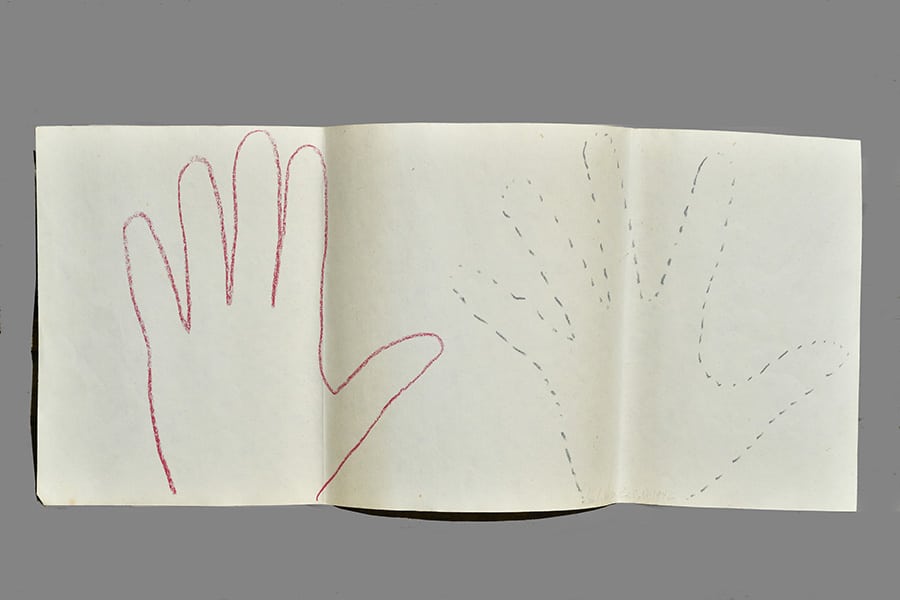
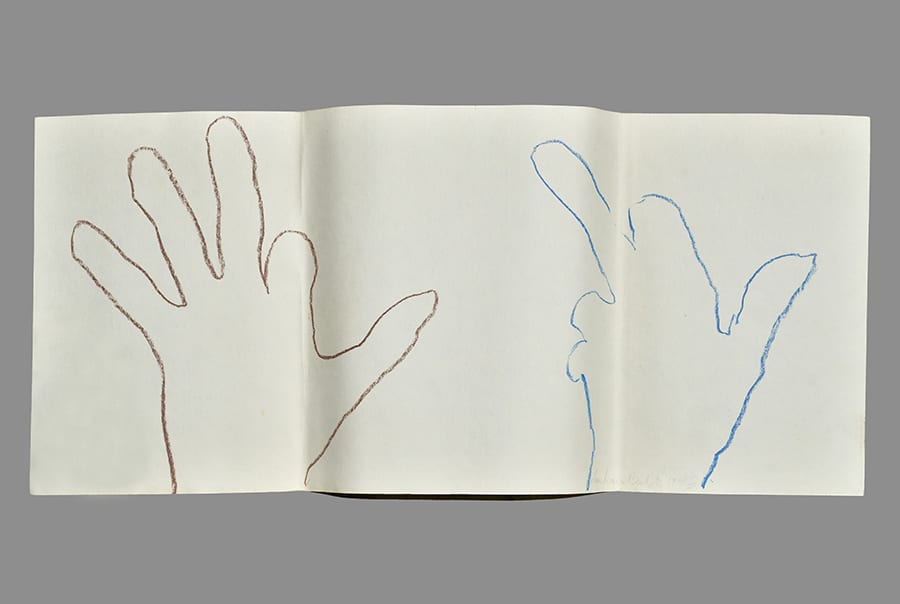
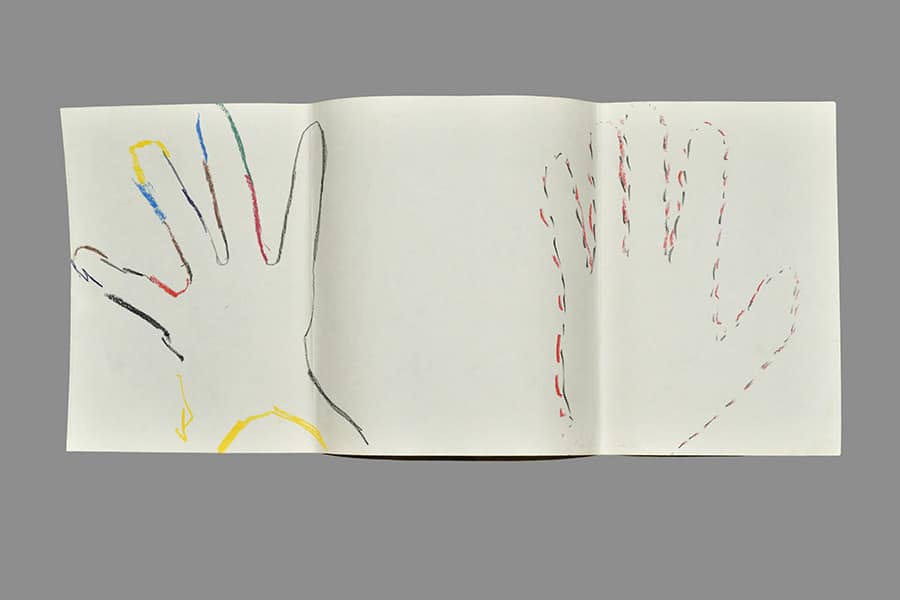
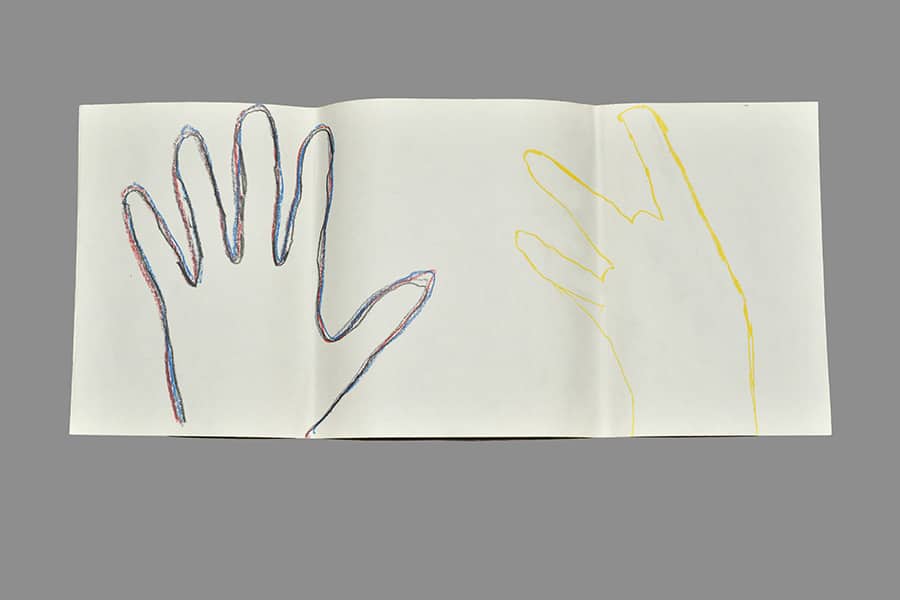
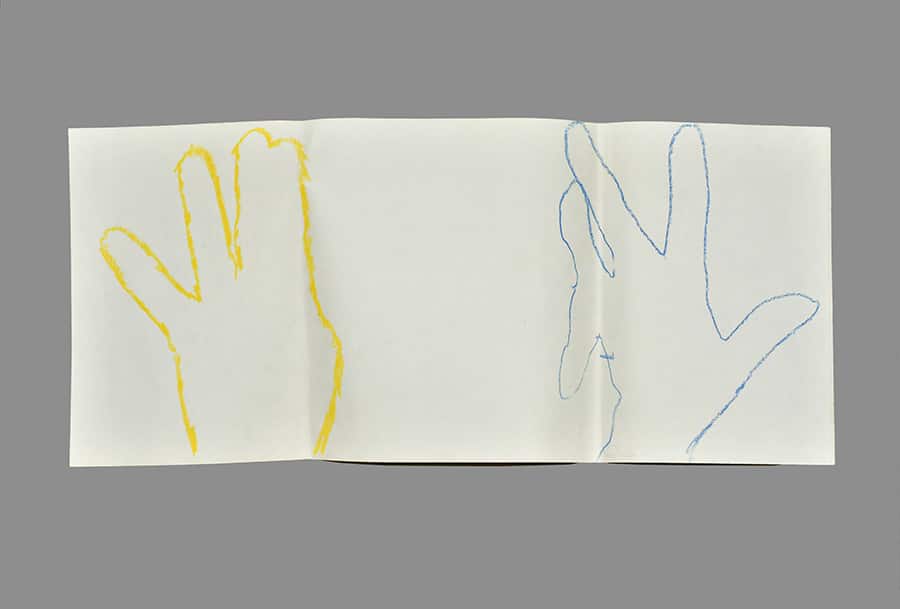
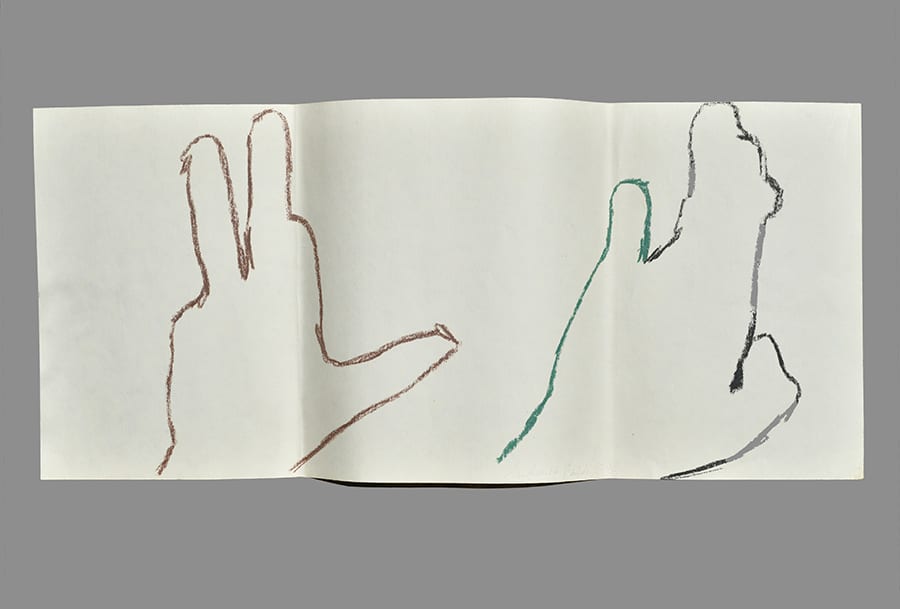
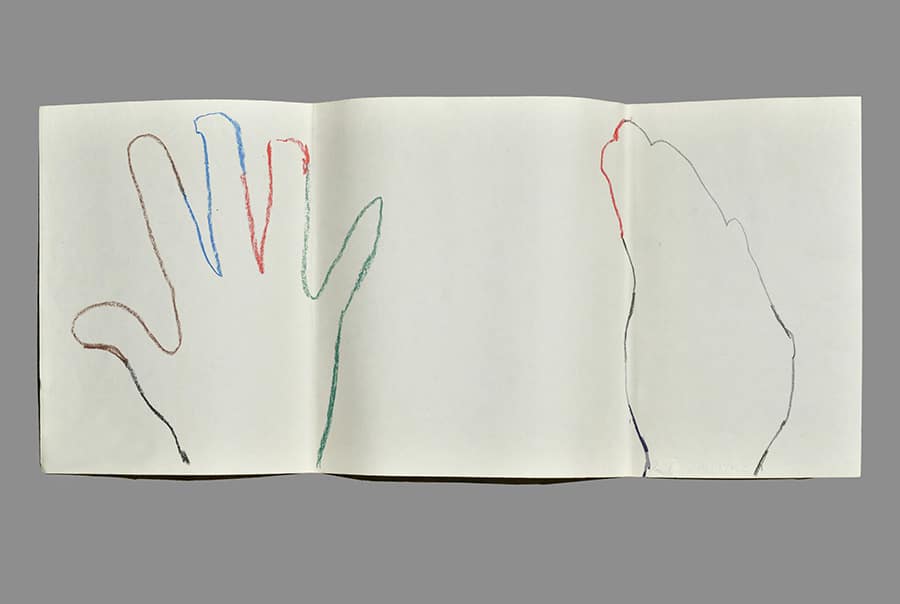
Showing hands, 1976.Sheets of paper with the silhouettes of the artist’s hands. Piero Biasion recalls: These sheets, arranged in horizontal strips, present the silhouettes of Lanfranco’s large hands in various positions. Found in the famous huge plywood folder with the spine made of glued jute, which he left me when he moved permanently to Florence from Genoa. I don’t know who suggested this attention to the hands. I used to photograph my hands to conclude the work sessions where the film was left over, as if to repeat the first sign of identity, presence, that one of our distant ancestors left in a cave in Lascaux.
Photo by Piero Biasion and Gianni Melotti , Text Lorenzo Bruni, translation Melared53